Social media made content creators rich, gave everyone a platform and changed how we spend our time. But as AI-generated content takes over our feeds, could the very thing that made these platforms successful be the thing that brings them down?
Four AI videos and I’m out
After four consecutive AI-generated videos, I close the app. I don’t care what happens next. I don’t need to see another cat rescuing a baby, a person doing something that defies the laws of physics, or a video that looks real until you notice that something is not quite right. I’m done. Facebook can carry on without me.
And I suspect I’m not alone.
AI has made it possible to produce videos, images and stories at a rate that would have been unthinkable a few years ago. Anyone can generate content in minutes, often without a camera, a production team, or even leaving their chair.
And that is where I think social media has a problem.
I didn’t join social media to watch an endless stream of computer-generated nonsense. I joined to see what people were doing, discover businesses, learn something, laugh at something someone had actually experienced, and keep up with people I know.
Are we getting tired of the scroll?
There are signs that at least some people are questioning their relationship with social media, although that does not necessarily mean they are abandoning it.
A 2025 Pew Research Center survey found that 45% of American teenagers felt they spent too much time on social media, up from 36% in 2022. The same research found that 44% had cut back on their social media use. These figures do not tell us whether AI content is responsible, but they suggest that the desire to spend less time scrolling is already there.
A 2025 Deloitte survey in the UK also found that one in five consumers had deleted a social media app in the previous 12 months, rising to 29% among Gen Z respondents.
Perhaps the question is not whether people are tired of social media itself, but whether they are tired of what social media has become.
There is a difference between opening an app because you want to see something and opening it because your thumb has developed a routine of its own.
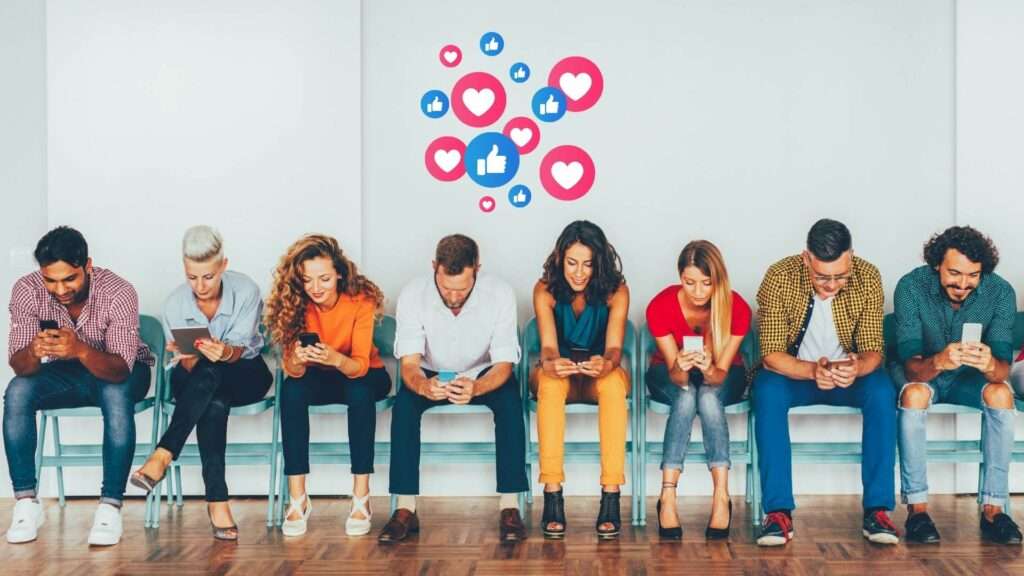
We have become very good at filling spare moments with scrolling. Waiting for someone? Scroll. Sitting on the toilet? Scroll. Waiting for the kettle to boil? Apparently, three seconds of silence is now unacceptable.
But what happens when the content no longer holds our attention? What happens when the feed becomes so saturated with content that we stop caring about any of it?
For me, the answer has been simple. I close the app.
So, why can’t I tell YouTube, Facebook or Instagram that I don’t want AI-generated content in my feed?
I can hide posts, unfollow accounts and indicate that I am not interested in certain topics. Yet there is no universal, straightforward setting that guarantees I will not see AI-generated content.
I simply want a choice.
Give users the option to reduce or exclude AI-generated content. Let people decide whether they want to see it, rather than assuming that because something generates views, everyone must want more of it.
After all, platforms rely on people spending time there. If the content becomes a source of frustration instead of entertainment, that time may start going elsewhere.
Could social media go the way of smoking?
I have been thinking about smoking lately, not because the two are the same, but because attitudes towards both can change over time.
There was a time when smoking was part of everyday life. It appeared in films, advertising, restaurants and social settings. It was normal, and in some circles it was seen as part of being fashionable.
Then attitudes shifted. Health concerns became harder to ignore, restrictions increased, and more people chose not to smoke. Tobacco companies did not disappear, but smoking became less acceptable in many parts of society.
Could social media follow a similar path?
Not necessarily through a sudden mass exodus, but through a gradual change in habits. Perhaps people will begin to question how much time they spend online. Perhaps younger generations will place more value on activities that do not involve a screen.
Perhaps spending an afternoon without checking a feed will become something people actively choose, rather than something they struggle to do.
There is already evidence of people cutting back, but the overall picture is mixed. Some groups are spending less time on certain platforms, while others continue to use them for hours each day. It is too early to declare that social media is in decline, let alone that AI will cause its downfall.
I chose a book. And it felt fantastic.
It has been years since I chose reading a book over doom scrolling, and I have to say, it feels fantastic.
There is something to be said for sitting down with a book and giving it your attention without checking notifications, watching a video or wondering what the algorithm has decided you should see next.
You finish a chapter instead of losing an hour. You follow a thought instead of jumping between twenty unrelated clips. You choose what enters your mind.
And the funny thing is, the internet has made information more accessible than ever, yet I sometimes feel as though I have less time to think.
I am not suggesting that everyone should delete their accounts and take up reading. Social media still serves a purpose. It connects people, helps businesses reach customers, gives creators an income and allows communities to form around shared interests.
I use it too, and I recognise its value.
But I would welcome a world in which using social media was a choice rather than a reflex, and where opening an app did not mean surrendering the next hour to an endless feed.
I don’t think AI alone will be the death of social media. It may, however, expose a problem that has been building for a while.
What interests me most is what happens to our habits over the next few years.
Will social media usage decline? Will people start demanding feeds that prioritise human-created content? Will original creators become more valuable because genuine human experiences are harder to find among all the generated material? Or will we simply adapt, accept AI content as part of the experience and carry on scrolling?
Maybe social media will adapt and find its place. Maybe another platform will come along and change everything. Or maybe we will look back on this period and wonder why we spent so much of our lives watching content we barely remember.
For now, I have a simple solution. Four AI videos, and I’m out.
The real question is whether enough other people will reach the same point to make the platforms pay attention.