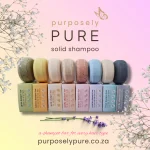
Shampoo bars have been popular overseas for a while, yet many South Africans are still working out what they are, how they foam and whether they are the same thing as soap. Spoiler: they are not.

To clear things up, we sat down with Marti-Mari Kellerman, founder and formulator of Purposely PURE.
She shares why she started making solid shampoo bars, how they differ from bottled shampoo, what to expect on your first wash and how to read an ingredient label without a chemistry degree. Grab a towel, because this one covers a lot.
Meet the Founder Behind Purposely PURE
Marti-Mari describes herself as passionate about natural products and loves formulating with botanical ingredients. She holds a Diploma in Natural Skincare Formulation from the School of Natural Skincare, International (UK) and has completed several courses and workshops in Solid Haircare Formulation. She is currently completing a Diploma in Natural Haircare Formulation as well.
Learning is a big part of her process. She researches what nature offers for formulation and uses that knowledge to test and develop every product. Her mission is to make natural products of exceptional quality available to everyone, and to highlight the value of products made with superior natural ingredients compared with the conventional products consumers often buy without a second thought.
The story starts with a personal switch. When Marti-Mari moved to natural personal care products, she could not find natural haircare that compared with conventional salon products. She eventually came across shampoo bars, which were already popular abroad but not yet readily available in South Africa.
Her goal was to offer naturally derived products without the harsh ingredients typical of conventional shampoos, while matching the performance of salon quality products.
What Makes a Natural Shampoo Bar Different?
It comes down to water. Shampoo bars are concentrated products that contain no water, which allows for a larger variety of ingredients and more active components. Conventional liquid shampoo can include up to 80% water, and that water-based formula limits which ingredients and actives can be included.
Purposely PURE bars are also free from sulphates, silicones, parabens and harsh synthetic additives commonly found in conventional liquid shampoo.
Why Do Customers Switch To Solid Bars?
Marti-Mari points to several reasons customers give:
Shampoo bars last long and are highly effective, often giving better results than liquid shampoos.
They are made from natural or naturally derived plant-based ingredients, with no sulphates, parabens, silicones or synthetic fragrances.
They are eco-friendly and biodegradable.
They are extremely convenient for travel.
Is a Shampoo Bar the Same as Soap?
No. This is the question Marti-Mari hears most often, along with whether a bar works like “normal” shampoo and whether it foams like regular shampoo. People frequently confuse shampoo bars with soap, which she describes as a completely different product type.
Her request is simple: stop calling it “shampoo soap.” She also wants shoppers to drop two assumptions at once, that a shampoo bar is similar to soap and that it will not foam well.
Using a Shampoo Bar for the First Time
What Surprises People Most?
The foam. People expect shampoo bars not to foam well, so they are usually surprised when they do. They are also surprised by how well the bar works and by how their hair looks and feels afterwards.
Do You Need to Change How You Wash Your Hair?
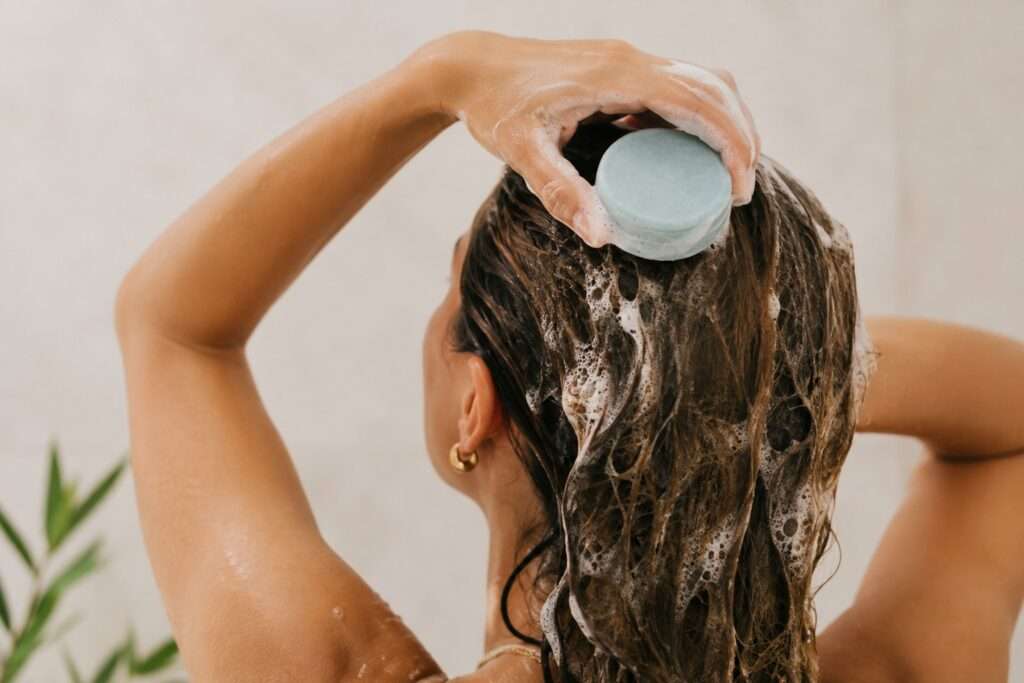
Only slightly. The application differs because you apply the bar directly onto the hair and scalp until it produces enough foam, but the washing process stays the same. Marti-Mari says it is generally more of a mindset shift than anything else.
How Long Does a Shampoo Bar Last?
Shampoo bars generally last 2 to 3 times longer than liquid shampoos, because they are concentrated and little product is needed per wash. The exact length depends on hair length and thickness, how often you wash and how much product you use per wash.
Care matters too. Marti-Mari stresses that the bar must dry out thoroughly between washes. Shampoo bars are designed to dissolve in water, so a bar left in a puddle or in the shower spray will become soggy and will not last long.
Are Shampoo Bars Suitable for All Hair Types?
Shampoo bars are generally suitable for all hair types, and Purposely PURE makes different bars for different hair types. The range includes Grow, Hydrate, Nourish, Soothe, Balance, Gentle, Fresh 2-in-1 Shampoo & Body Wash and Clarify, each formulated with a specific hair or scalp need in mind.
There is one important note. All Purposely PURE products contain pure essential oils and are not tested for medical conditions. Marti-Mari does not recommend them to anyone with a known sensitivity or allergy to essential oils, or to anyone who requires specific medical treatment.
What Do People Ask Before Switching?
Most people want to know how to use a shampoo bar and whether it works like “normal” shampoo. The foam question comes up often, and so does the soap confusion covered above.
What Does Marti-Mari Wish People Knew Before Buying Shampoo?
She wishes more people knew how to read ingredient labels and were better informed about the harmful and harsh ingredients present in many off-the-shelf products. In her view, the ingredients commonly found in conventional products include sulphates, parabens, phthalates, synthetic colourants, fragrance or parfum, PEGs, formaldehyde and, most frequently, petroleum-based ingredients and mineral oils.
Which Shampoo Claims Should Consumers Question?
Front-of-pack marketing claims. Phrases such as “active ingredients from nature” or “with XYZ ingredients” can lead shoppers to think a product is more natural than it is. Marti-Mari says that when the ingredient list is investigated, it is often filled with harsh synthetic ingredients and only a small percentage of natural ones. The advertised ingredients are often present in an insignificant amount.
What Should You Check When Comparing Two Shampoos in a Shop?
Compare the ingredient lists and look for the harsh synthetic ingredients to avoid: sulphates, parabens, silicones, PEGs, petroleum derivatives and synthetic fragrances and colourants. Marti-Mari’s recommendation is always the product without these ingredients, or the more natural option.
How Do You Read a Confusing Ingredient List?
Marti-Mari’s tips for decoding a label:
Ingredients must legally be listed in order from the highest percentage to the lowest.
Anything below 1% can be listed in any order.
Water often sits at the top of the list, and it appears as “aqua”.
Ingredients are listed by INCI (international chemical or Latin) names. The common name is often given in brackets after the chemical name, so look for those.
You can search for harsh synthetic ingredients to avoid, such as the “dirty dozen” skin and haircare ingredients.
Website tools such as Incidecoder can simplify and analyse the ingredients for you.
Her overall advice is to educate yourself and learn to read labels on your own.
Would She Ever Say Something Just to Make a Sale?
Never. Marti-Mari always tries to be completely honest when a client asks about their specific needs and never makes false claims about her products, even if that means losing the sale.
Key Takeaways from the Interview
Solid shampoo bars contain no water, so they hold a larger variety of ingredients and more active components than liquid shampoo.
They generally last 2 to 3 times longer than a bottle of liquid shampoo, as long as the bar dries out between washes.
Washing stays the same, and the bar foams.
A shampoo bar is not soap.
Products containing essential oils are not suited to people with a known sensitivity or allergy to essential oils.
Reading the ingredient list, not the front of the pack, tells you what is in your shampoo.
Marti-Mari’s story started with a search for natural haircare that could match salon products, and it led to Purposely PURE and a range of solid shampoo bars for different hair types. Her advice reaches beyond her own products: learn to read labels, question front-of-pack claims and pick the option with fewer harsh synthetic ingredients.