What Happens While You Sleep?
You go to bed, close your eyes and fall asleep. From your perspective, the night may seem to pass without much happening.
For someone with obstructive sleep apnea, however, there can be a lot happening between falling asleep and waking up.
Breathing can stop or become restricted repeatedly during the night. Oxygen levels can fall. The brain can briefly wake the body to restore breathing. This can happen many times in an hour, often without the person being aware of it.
This is one reason sleep apnea can be difficult to understand. You may spend eight hours in bed and still wake up feeling as though you have barely slept.
The good news is that CPAP and APAP technology has moved beyond simply blowing air through a mask. Modern PAP machines can use remote sleep monitoring to provide information about usage, breathing events, pressure and other treatment data.
For people already using PAP therapy, or those looking for a CPAP or APAP machine in South Africa, this means there is more to consider than simply asking, “How much does the machine cost?”
The more important question may be: How well is it treating my sleep apnea?
What actually happens when you have sleep apnea?
Obstructive sleep apnea occurs when the upper airway becomes blocked or narrowed during sleep.
As the muscles around the airway relax, the tissues in the throat can partially or completely obstruct the flow of air. You may continue trying to breathe, but less air reaches your lungs.
Eventually, your brain responds to the problem.
You may briefly wake up or move into a lighter stage of sleep, allowing the airway to open again. You may gasp, snort or take a deep breath before falling asleep again.
Then it can happen again.
And again.
And again.
These interruptions can occur without you remembering them the next morning. In some people, they can happen dozens of times per hour.
The Apnea-Hypopnea Index, or AHI, is one of the measurements used to describe the frequency of breathing interruptions during sleep. An AHI of 5 to less than 15 events per hour is generally classified as mild obstructive sleep apnea, 15 to less than 30 as moderate, and 30 or more as severe.
The number matters because it gives healthcare professionals a way of assessing the frequency of these events. But your experience of sleep apnea is about more than one number.
Why interrupted breathing matters
Every time your airway becomes obstructed, your body has to respond. Remote sleep monitoring allows your healthcare professional to review your therapy data and track how your treatment is working over time.
Sleep may be interrupted. Oxygen levels can fall. Your heart and blood vessels can be placed under additional stress. The repeated effort required to restore breathing can prevent you from getting the restorative sleep your body needs.
Untreated sleep apnea has been associated with problems including daytime sleepiness, difficulties with concentration and memory, high blood pressure, cardiovascular disease and stroke.
This is why treating sleep apnea is not simply about stopping snoring.
It is about keeping your airway open and helping you breathe consistently while you sleep.
CPAP vs APAP: what is the difference?
CPAP stands for Continuous Positive Airway Pressure.
A CPAP machine delivers a set level of air pressure through a mask while you sleep. The pressure helps prevent the upper airway from collapsing.
APAP stands for Auto-Adjusting Positive Airway Pressure.
Instead of delivering one fixed pressure throughout the night, an APAP machine can automatically adjust the pressure according to changes in your breathing.
This can be useful because your breathing is not necessarily the same throughout the night.
Your pressure requirements can change depending on your sleep position, sleep stage and other factors. An APAP machine can respond to these changes rather than relying on one fixed pressure throughout the night.
Modern PAP machines can therefore do more than provide air pressure. They can also collect information about your therapy.
And that information is where things get interesting.
What can your CPAP or APAP machine tell you?
Imagine waking up in the morning and knowing more about what happened during your sleep than simply whether you feel tired.
Modern PAP therapy can provide information about your treatment, including how long you used the machine and whether your therapy is reducing breathing events.
Your machine may also provide information related to mask leaks and pressure requirements, depending on the model and software available.
This gives you and your healthcare professional something important:
Data.
Instead of relying only on how you feel in the morning, treatment can be assessed using information collected while you were actually asleep.
This does not mean that you should diagnose yourself from the numbers on your machine. Sleep therapy data needs to be interpreted in the context of your diagnosis, symptoms and treatment plan.
But it can help your healthcare provider identify whether your current therapy is doing what it is supposed to do.
The National Heart, Lung, and Blood Institute notes that PAP data can be used to see how often a patient uses the device and whether the device and its settings are working to reduce or eliminate apnea events.
Why remote monitoring changes CPAP treatment
This is where newer connected PAP machines start to change the experience for patients.
Traditionally, reviewing your CPAP therapy could involve bringing information from the machine to a healthcare professional during a consultation.
Connected technology can make that process more immediate.
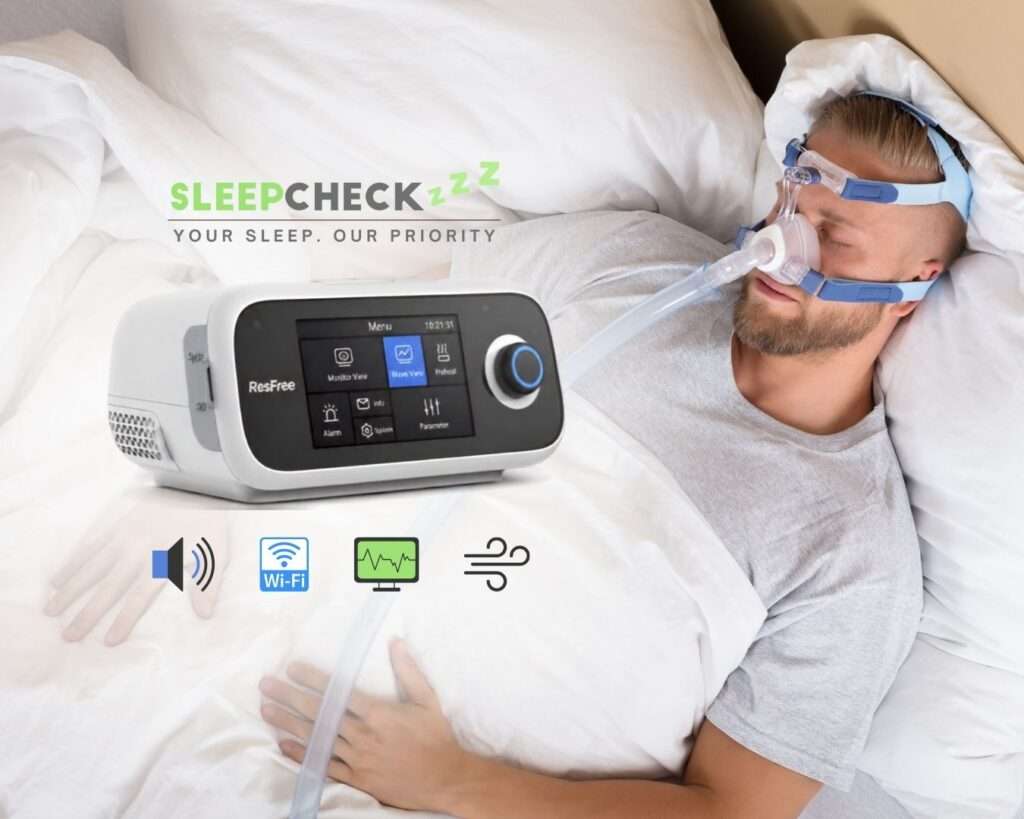
The ResFree R-20A APAP from SleepCheck, for example, includes WiFi connectivity and a cloud-based health management platform. Therapy usage data can be uploaded automatically, allowing SleepCheck’s team to review how the device is being used and how treatment is progressing.
If there is a problem with your mask fit, pressure requirements, usage or therapy results, the data can provide your healthcare team with information to investigate.
With the R-20A, SleepCheck says authorised doctors and family members can also access the information when permission has been granted, and reports can be generated to support treatment and diagnostic decisions.
Meet the ResFree R-20A APAP
For South African patients looking at current PAP technology, the ResFree R-20A is one option worth considering.
The machine operates in both CPAP and APAP modes, with a pressure range of 4 to 20 cmH₂O. In APAP mode, it can automatically respond to changes in breathing during the night rather than maintaining one fixed pressure.
The R-20A also includes three boost sensitivity settings. These allow the response to pressure changes to be adjusted according to the patient’s needs.
But the biggest difference is not simply the pressure range.
It is the connectivity.
The R-20A can connect to a cloud-based platform through WiFi, allowing treatment data to be monitored remotely. SleepCheck can use this information to assess therapy and, where clinically appropriate, make adjustments remotely.
For someone who travels regularly, lives far from a practice or simply does not want every adjustment to require another appointment, this can make a difference. With remote sleep monitoring, important sleep therapy data can be shared with your healthcare team without requiring you to bring your machine in for every review.
What else does the R-20A offer?
The machine includes a number of features designed around everyday PAP therapy.
It has an integrated humidifier with adjustable levels, which can help address dryness associated with PAP therapy. It also has a ramp function of up to 60 minutes, allowing pressure to increase gradually while you fall asleep.
Automatic leak compensation can help maintain therapy when small changes in mask fit occur during the night, while automatic altitude adjustment is intended to maintain therapy when travelling between different elevations.
The machine is also designed for use while travelling, weighing 1.37 kg and measuring 243 mm × 181 mm × 110 mm. SleepCheck lists its operating noise at 26 dBA or lower.
These features may sound like small details, but anyone who uses PAP therapy knows that small details can determine whether a machine becomes part of your nightly routine or ends up sitting beside the bed.
Your numbers can tell a story
One of the biggest changes in PAP technology is the ability to see what is happening during treatment.
Think about your AHI.
If your untreated sleep study showed frequent breathing interruptions, your treatment goal is not simply to wear the mask for a certain number of hours. The goal is to treat the breathing disorder.
Your therapy data can help your healthcare professional see whether your treatment is reducing breathing events.
Other information can also provide clues.
For example, excessive leak information may indicate that your mask needs attention. Changes in pressure requirements may provide useful information about your therapy. Usage information can show whether you are actually getting consistent treatment.
This is particularly important because PAP therapy works when you use it.
The NHLBI recommends using PAP whenever you sleep, including naps, and notes that mask fit, pressure settings, humidification and other factors can affect the experience of treatment.
What if your numbers are not where they should be?
This is an important point for anyone buying a modern CPAP or APAP machine.
More data does not mean you should become your own sleep specialist.
A machine can show you information, but a healthcare professional needs to interpret that information alongside your symptoms, medical history and diagnosis.
If your AHI remains high, if you are experiencing significant leaks, if you are still excessively sleepy during the day or if PAP therapy is uncomfortable, those are reasons to speak to your healthcare provider.
The answer might involve changing the mask, adjusting settings, changing the type of PAP therapy or investigating another issue.
In other words, the data is there to start a conversation, not replace the conversation.
What should you look for when choosing a CPAP or APAP machine in South Africa?
If you have been diagnosed with obstructive sleep apnea and are comparing machines, look beyond the price tag.
Consider:
• Does it offer CPAP, APAP or another form of PAP therapy that is appropriate for your diagnosis?
• Can it record useful therapy data?
• Can your healthcare professional access and interpret that information?
• Does it offer remote monitoring?
• Can the pressure be adjusted to your treatment requirements?
• Does it have humidification if you experience dryness?
• Does the mask fit correctly and comfortably?
• Is there local support if something goes wrong?
• Are replacement masks, filters, tubing and other consumables available in South Africa?
• Can the supplier assist with setup and ongoing therapy?
These questions can be more useful than simply asking which machine is “the best”.
The best machine is the one that suits your diagnosis, prescribed treatment, lifestyle and ability to use it consistently.
Technology is changing what it means to use CPAP
CPAP therapy has been around for decades, but the machines available today are not simply versions of the machines patients used years ago.
APAP technology can respond to changes in breathing. Humidification can address some of the discomfort associated with therapy. Data recording can provide information about treatment. Connected machines can allow healthcare professionals to monitor therapy without requiring every review to happen face-to-face.
The ResFree R-20A brings these developments together in a machine designed for obstructive sleep apnea treatment, with CPAP and APAP modes, automatic pressure adjustment and remote monitoring through a connected platform.
For patients, the biggest benefit may not be another feature on a specification sheet.
It may be knowing that someone can look at what your machine is recording and help you understand whether your treatment is working.
Because when you are asleep, you cannot tell someone how you are breathing.
Your machine can collect part of that story.
And with connected PAP technology, your healthcare team can be closer to the story too.
Looking for a CPAP or APAP machine in South Africa?
If you are looking for CPAP machines for sale in South Africa, it is important to choose a machine that suits your prescribed treatment and individual needs. SleepCheck supplies CPAP, APAP and BiPAP equipment in South Africa and provides treatment assistance, setup and support. The ResFree R-20A is available as part of its PAP range and includes remote monitoring capability.
If you have been diagnosed with sleep apnea, speak to your doctor or sleep healthcare professional about the type of PAP therapy that is appropriate for you before choosing a machine.
Sleep therapy should not be a guessing game.
The more you know about what happens while you sleep, the more useful your treatment data can become.